
CEM
3D Electromagnetics
Coplanar Waveguide S-Parameters
Four-Port Sweep on Anisotropic Sapphire with the Palace Finite-Element Solver
Explore GPU-accelerated computational electromagnetics (CEM) powered by NumericalAI and the open-source Palace 3D finite-element solver. This study extracts the full scattering matrix of a coplanar waveguide (CPW) — the workhorse transmission line for superconducting-qubit chips and high-frequency RF circuits.
The example bundles four driven frequency-domain runs of the same four-port CPW on anisotropic sapphire. They compare two ways to feed the line — mode-accurate numeric wave ports versus lumped ports — and two ways to sample the band — a uniform grid versus an adaptive fast-frequency sweep that reconstructs the entire response from a handful of full solves.
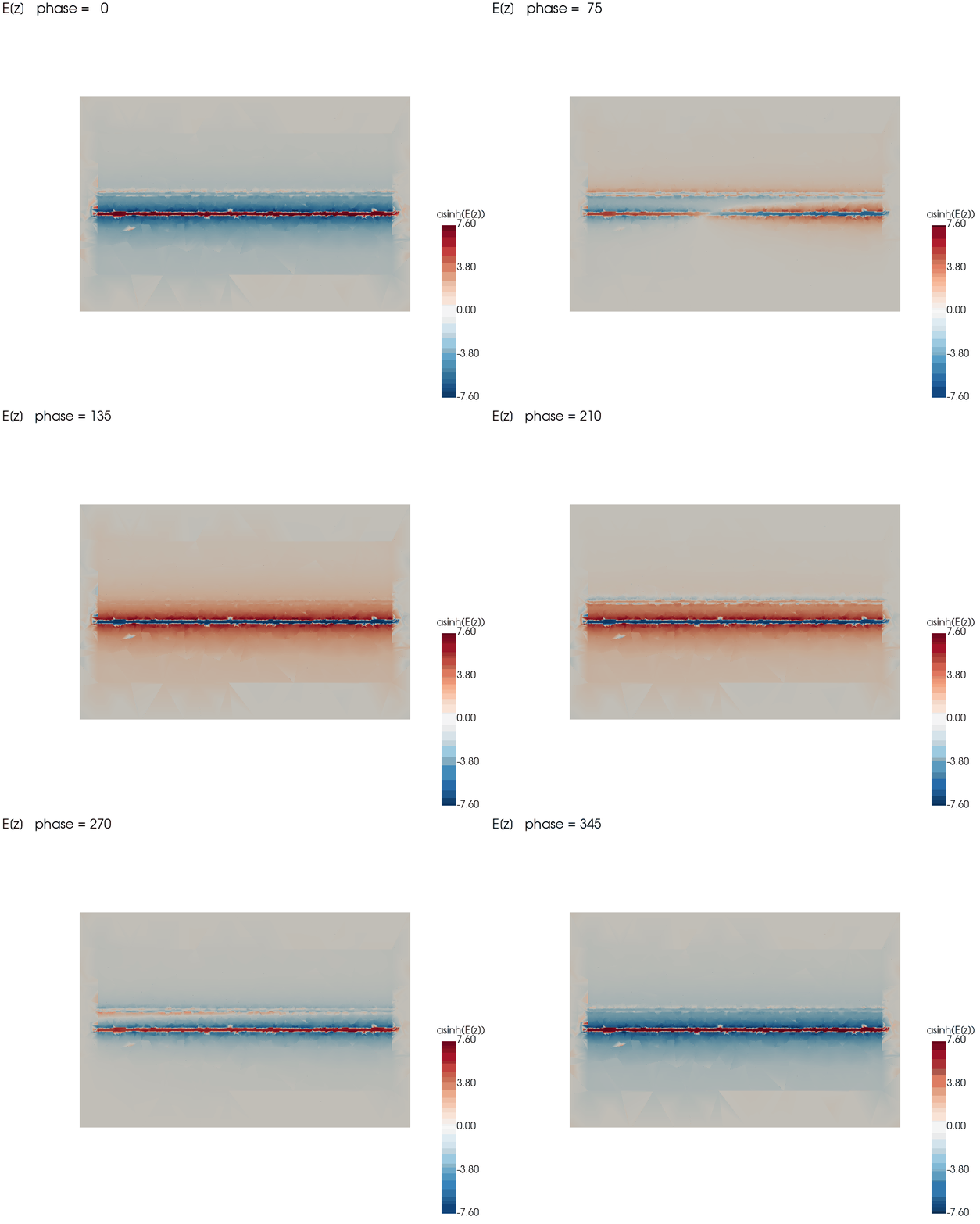
Out-of-Plane Electric Field E(z)
The complex field (asinh-scaled) animated over one phase cycle. The signal is tightly confined to the gaps between the center trace and the ground planes — the hallmark of a coplanar waveguide — while the anisotropic sapphire below pulls the field asymmetrically into the substrate.
Adaptive sweep (dense)
Uniform sweep (2 GHz grid)
Return loss |S₁₁| of the CPW versus frequency. The uniform-grid samples land exactly on the adaptive curve, yet the coarse grid completely misses the sharp −40 dB resonant notch near 15.4 GHz — the whole point of an adaptive sweep, which adds sample points only where the response changes rapidly.
Four Runs, One Model
Each run solves the identical CPW geometry but changes how the ports are modeled and how the frequency band is sampled. Cross-comparing them validates the fast, cheap approximations against the rigorous, expensive reference.
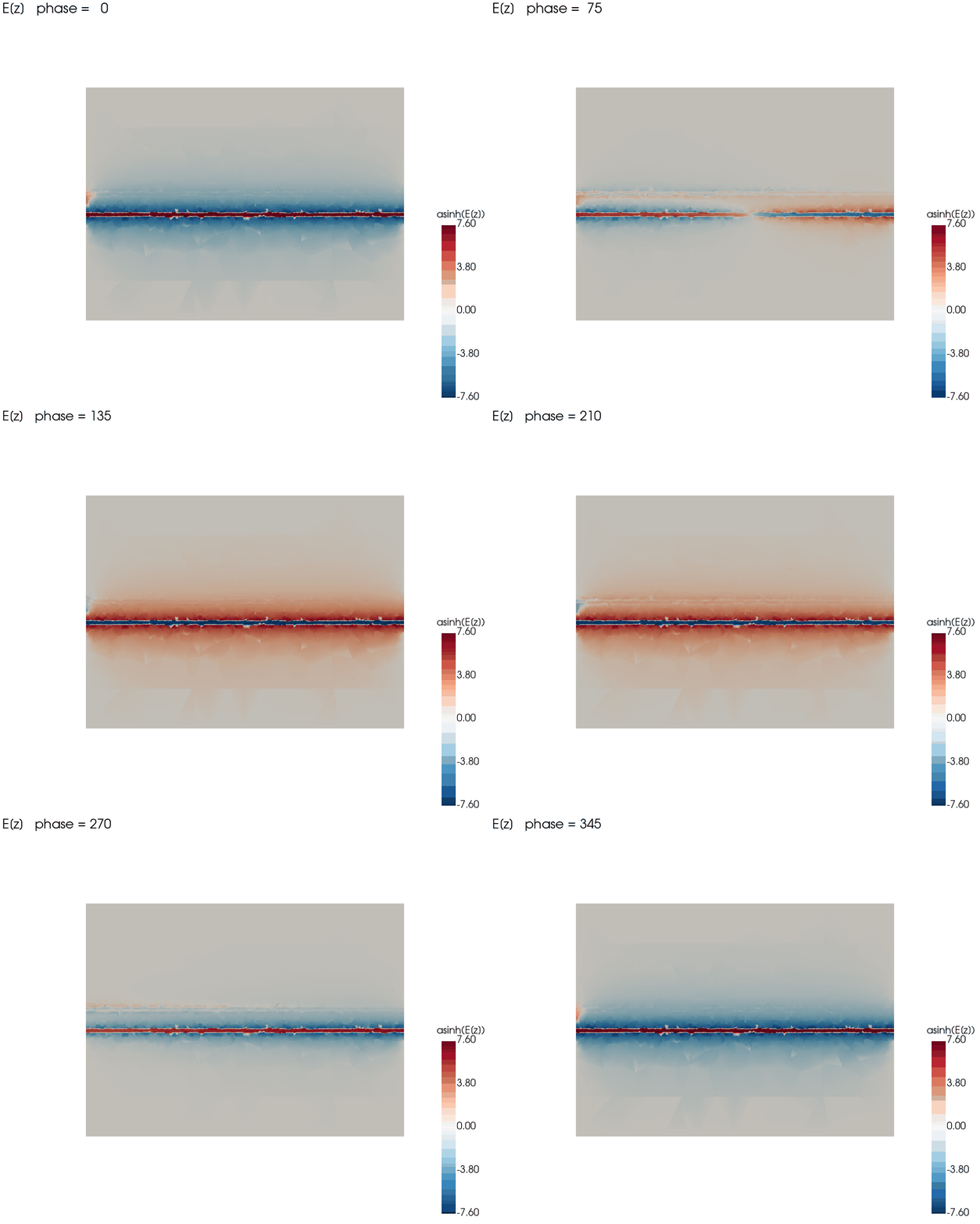
Wave Ports · Uniform
Numeric wave ports solve a 2D modal eigenproblem on each port face, so the excitation matches the true propagating CPW mode. Sampled on a coarse 6 GHz grid — the mode-accurate reference.
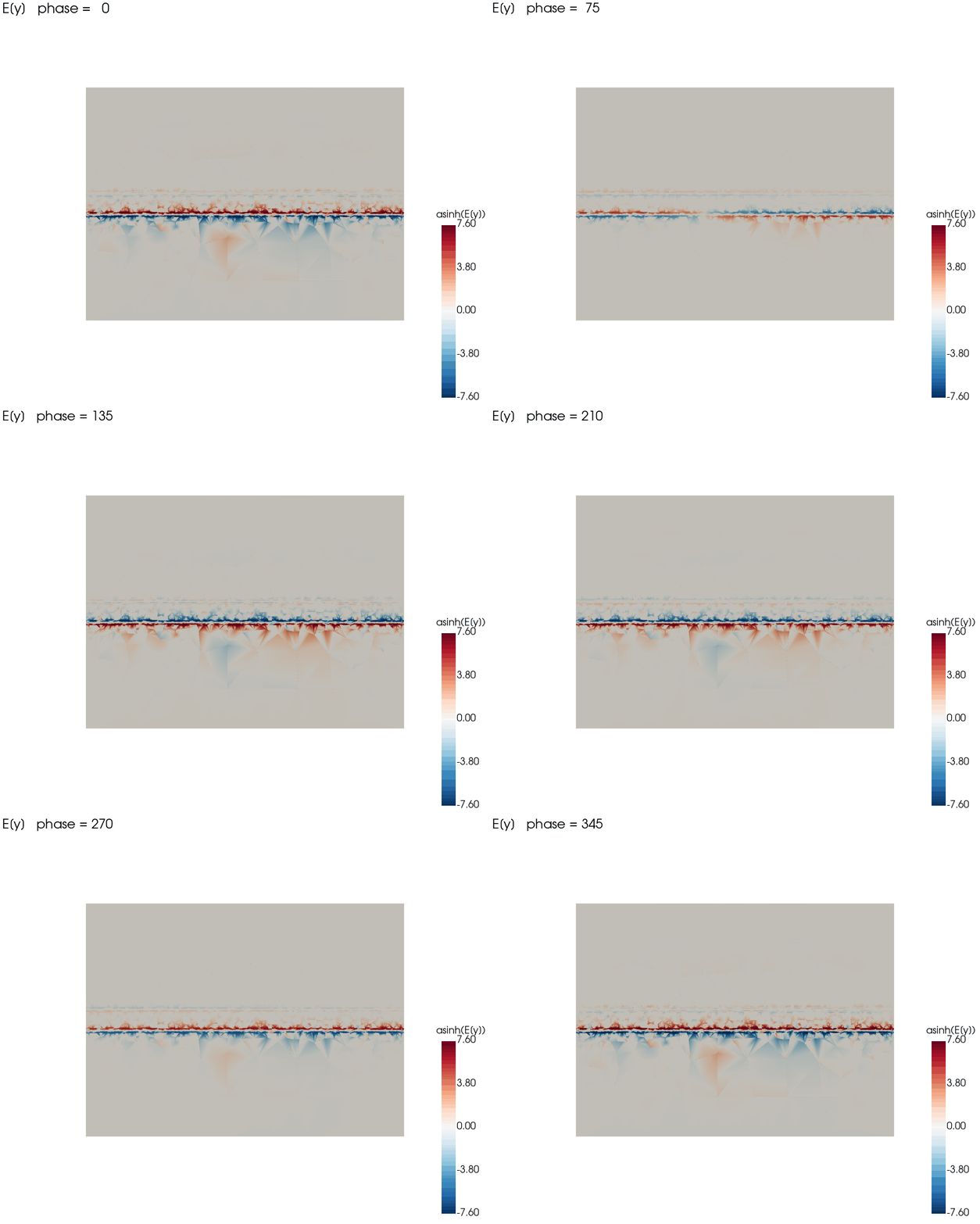
Coaxial Lumped · Uniform
Coaxial-style lumped ports drive the line through radial feed faces (emulating a connectorized launch), sampled on a uniform 2 GHz grid. A fast, connector-like approximation of the feed.
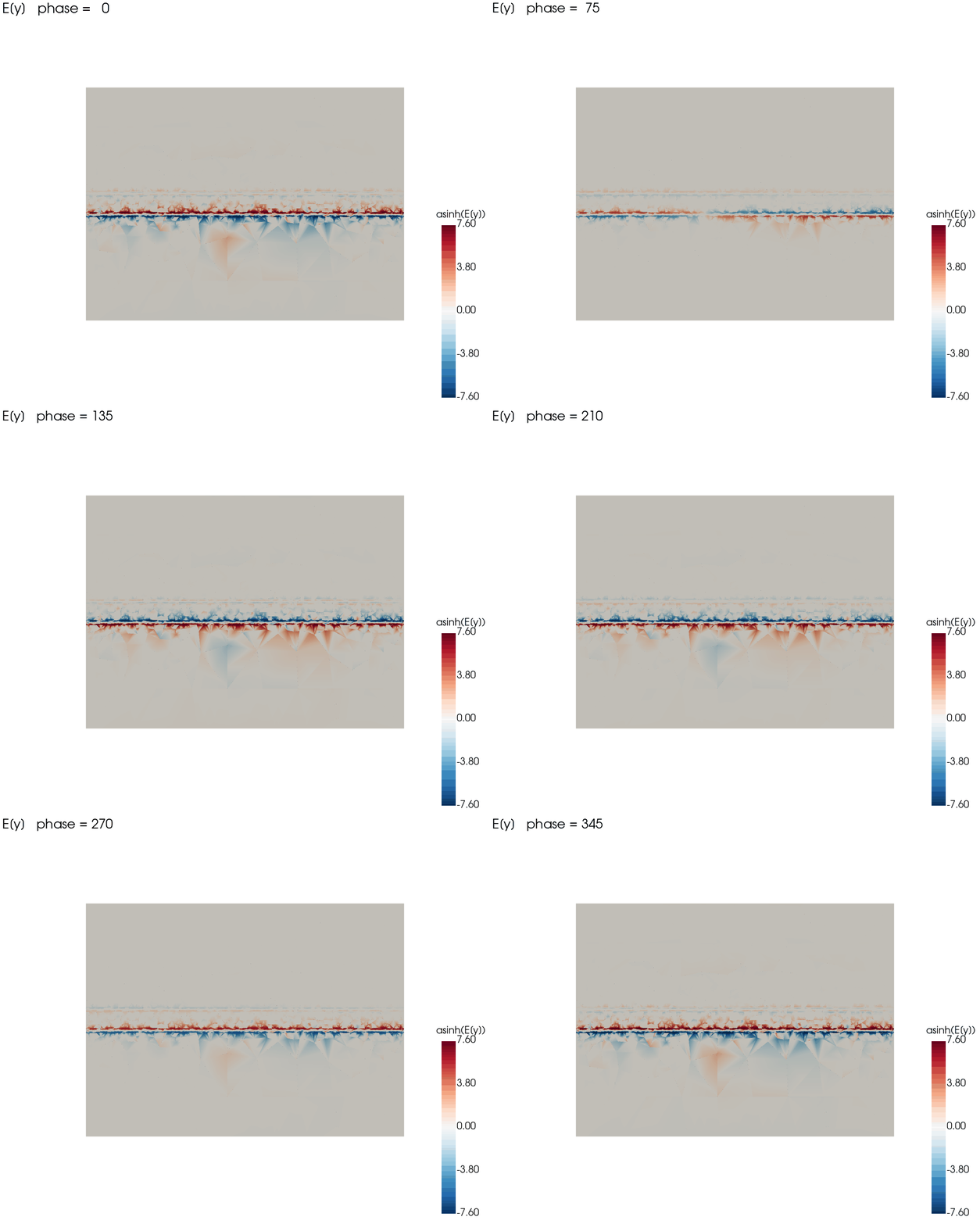
Coaxial Lumped · Adaptive
The same coaxial-lumped model solved with an adaptive fast-frequency sweep. It reproduces the uniform result exactly at the sample points while resolving the full band between them.
Gap Lumped · Adaptive
Multi-element gap lumped ports (±Y pairs) with an adaptive sweep across 2 → 32 GHz, producing a dense 300-point response from roughly ten full solves.
Simulation Configuration
Geometry & Mesh
Structure:
4-port CPW
Length scale:
μm (L₀ = 1e-6)
Mesh Elements:
~16,800
Element Order:
2
Degrees of Freedom:
~121,600
Materials
Substrate:
Anisotropic sapphire
Permittivity:
[9.3, 9.3, 11.5]
Upper region:
Air
Crystal axis:
Rotated
Solver
Problem type:
Driven
Krylov:
GMRES
Preconditioner:
Multigrid
Tolerance:
1e-8
Adaptive tol:
1e-3
Boundary Conditions
Metal trace:
Perfect electric conductor (PEC)
Ports 1–4:
Wave / lumped, R = 56.02 Ω
Outer box:
1st-order absorbing
Computational Performance (adaptive run)
~300
Frequency Points
~10
Full Solves
CUDA
NVIDIA GPU
122K
Degrees of Freedom
Return Loss Across the Band
A sample of |S₁₁| (dB) from the coaxial-lumped model. The adaptive sweep matches the uniform grid at shared frequencies and captures the deep resonant notch near 15.4 GHz that the coarse grid steps right over.
| Frequency (GHz) | |S₁₁| (dB) | Behavior |
|---|---|---|
| 2.0 | −16.6 | Well matched |
| 8.0 | −9.1 | Mismatch ripple peak |
| 14.0 | −19.1 | Approaching resonance |
| 15.4 | −40.2 | Sharp resonant notch |
| 20.0 | −11.4 | Mid-band ripple |
| 23.0 | −9.8 | Mismatch ripple peak |
| 30.0 | −28.4 | Second match point |
What the S-Parameters Reveal
Standing-Wave Ripple & Resonances
The periodic dips and peaks in |S₁₁| come from the finite length of the CPW: whenever the line spans an integer number of half-wavelengths, reflections cancel and the return loss plunges (the notches near 15.4 GHz and toward 30 GHz). Between those points, small impedance mismatches produce the characteristic ripple. Reading the notch spacing back out gives the effective permittivity and phase velocity of the guided mode.
Why Anisotropic Sapphire Matters
Sapphire is the substrate of choice for superconducting qubits, but its permittivity is direction-dependent ([9.3, 9.3, 11.5] with a rotated crystal axis). That anisotropy shifts resonances and coupling in ways a scalar-permittivity model gets wrong — so a full-wave solver that handles tensor materials is essential for trustworthy design.
Why the Adaptive Sweep Wins
Full-band resolution from ~10 solves — a reduced-order model interpolates S(ω) across hundreds of points instead of solving each one
Samples where it matters — points are added only where a residual estimator exceeds tolerance, so sharp resonances are never missed
Validated against wave ports — lumped-port approximations are checked against mode-accurate numeric wave ports on the same mesh
Industrial Applications
Superconducting Qubits
Feedline and coupler S-parameters, CPW crosstalk, and resonance identification for quantum processors on sapphire — with interface-loss budgeting.
RF & Microwave Circuits
Dispersion-aware CPW design, filters, and couplers where accurate broadband S-parameters drive first-pass-correct silicon.
Package & Interconnect
Connectorized launches and package-to-chip transitions, characterized with coaxial-style feeds and multi-port de-embedding.
Signal Integrity
Broadband insertion/return loss for high-speed links, with dense frequency responses delivered without a full solve per point.
Why NumericalAI for Electromagnetics
Powered by Palace — AWS's open-source, GPU-accelerated 3D finite-element solver for full-wave electromagnetics
Wave and lumped ports — mode-accurate excitations plus fast lumped approximations, with multi-port de-embedding
Adaptive fast-frequency sweeps — dense broadband responses from a few solves, with anisotropic (tensor) material support
Cloud GPUs on demand — no local HPC cluster or solver installation required
Business Value & ROI
NumericalAI brings production-grade electromagnetic simulation to an intuitive cloud interface — no solver installation, no cluster administration, no meshing bottleneck.
Faster characterization: an adaptive sweep delivers a dense broadband S-matrix from a handful of solves, so RF and quantum-hardware teams find resonances and loss mechanisms in minutes instead of hours.
Ready to Extract Your S-Parameters?
Run full-wave, multi-port electromagnetic simulations with Palace on NumericalAI. Upload your Palace config.json and mesh, and get broadband S-parameters on cloud GPUs.
AI-Assisted GPU-Powered Simulations
© 2026 NumericalAI, all rights reserved. |Privacy Policy |Terms of Service |Executive brief |CEM vs HFSS |FAQ